


Previous: March 2022 • May 2022 • August 2022 • February 2023 • June 2023 • December 2023 •
COSN Federal NDP Updates | March 2022
At The Moment - Invasions, Convoys and Recoveries
Our hearts go out to the people of Ukraine. We find ourselves in another climactic geopolitical event that will change the course of our lives, and while the war in Europe is geographically far removed from the day-to-day of most of us in the COSN riding, we can’t help but feel for the struggles of all the innocent people and their families trapped in this life threatening situation.
Jagmeet Singh & the NDP have successfully pushed for visa-free admittance of Ukrainian refugees seeking safety in Canada and have advocated along with others for strong sanctions applied against Russia.These are important humanitarian and economic responses, and demonstrate some minimum steps towards addressing the conflict. There are obviously far more actions that must be taken to cool this situation to a point where we, the people of this world, can realistically return to a place of hope. If an end to this conflict in Ukraine is to be found, let it be through morally courageous means and not by the barrel of a gun. We strongly urge Canadian politicians and military advisors to also remember our peacekeeping legacy in international conflict zones.
The anti-government convoy demonstrations that unfolded across Canada throughout February are put into sharp relief by the events in the Ukraine. Putin’s invasion makes it clear what actual authoritarian overreach looks like, in contrast to the reasoned and tolerable government actions of implementing public mask mandates and vaccine campaigns. The radical fringe protesters called for the blanket removal of public health measures claiming that the actions infringe on their individual rights. Removing the measures, implemented to ensure workplace safety in an ongoing pandemic, would achieve the opposite of freedom. Workers would be forced to participate in unsafe working conditions and the immunocompromised would be further isolated if the public was not required to do their part in protecting vulnerable populations. Perhaps Putin’s invasion tactics will remind protesters that small, community-minded measures of personal sacrifice and inconvenience are relatively insignificant in comparison to losing your sovereign homeland. See what Peter Julian has to say about the protesters: https://www.facebook.com/MPPeterJul...
In our own riding, many people in 2021 were forced to reckon with the first hand consequences of climate change, dealing with extreme fires in Logan Lake, around Merritt and nearby Lytton, and as well as devastating floods in Merritt and Princeton. The recent environmental events were shocking in their force and magnitude, and many people continue to be overwhelmed with the scope of the recoveries in their communities.
Mark your calendars for Sunday March 13th, 2022 for the Hell or High Water disaster relief concert & telethon. Tune in and donate, if you can, at https://hellorhighwater.ca/.
For better or for worse, emergencies present opportunities for us to declare our intentions; we are ready to make things better, aligned with the Federal NDP commitments for 2021-22. READY FOR BETTER! https://www.ndp.ca/commitments
We would love your feedback, and we extend an invitation to everyone to contribute to upcoming editions of COSN Updates. If you have an opinion, a story, an event or a photo that you want to share from your corner of the riding, please contact COSN Updates editors:
• Jeannette Angel (jeannetteangel.ndp@gmail.com), or
• Trevor McAleese (trevor.mcaleese@gmail.com)
Lim’limpt,
Jeannette & Trevor (President & Vice President, COSN Federal NDP Riding Association)
All Around the Riding
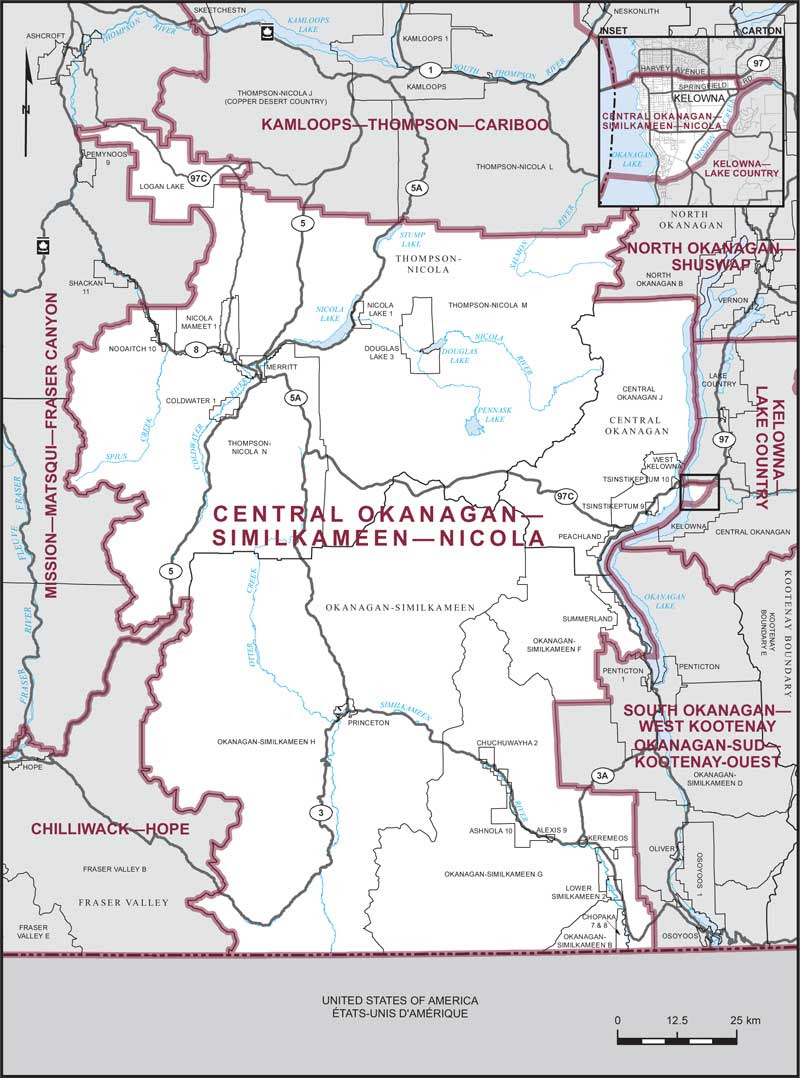
Electoral District Map
The boundaries of the Central Okanagan-Similkameen-Nicola federal riding represent a vast geographic area in the province of British Columbia. Connecting the many NDP communities across COSN is no small feat, but a reasonable starting point is to remind ourselves of the uniqueness of the places where people live and the value of their stories.
Meet Your Riding Executive - An Introduction
• President – Jeannette Angel (Kelowna)
• Vice-President – Trevor McAleese (Kelowna)
• Financial Agent – Susan Davenport (West Kelowna)
• Secretary – Stella Holliday (Princeton)
• Membership Secretary – Norah Bowman (Kelowna)
• Disability Representative – Spring Hawes (Kelowna)
• Youth Representative – Zachary Jwaszko (Kelowna)
• 2019 and 2021 Candidate – Joan Phillip
Members at Large:
• Grand Chief Stewart Phillip (Penticton)
• Donna Stocker (Cawston)
• Kim Ruttig-English (Keremeos)
• Dale O'Flynn (Kelowna)
• Denise Williams (Merritt)
Checking In with Joan Phillip
Our NDP candidate in the federal 2019 and 2021 elections, Joan remains interested in running as a candidate to be your Member of Parliament in the next election. On Sunday February 27th, 2022, Joan Phillip (with an appearance from Grand Chief Stewart Phillip) had a heartfelt conversation with Jeannette Angel about a range of challenges people are facing far and near. This account of the conversation is from Jeannette’s perspective, witnessing the clarity and strength of their words and actions.
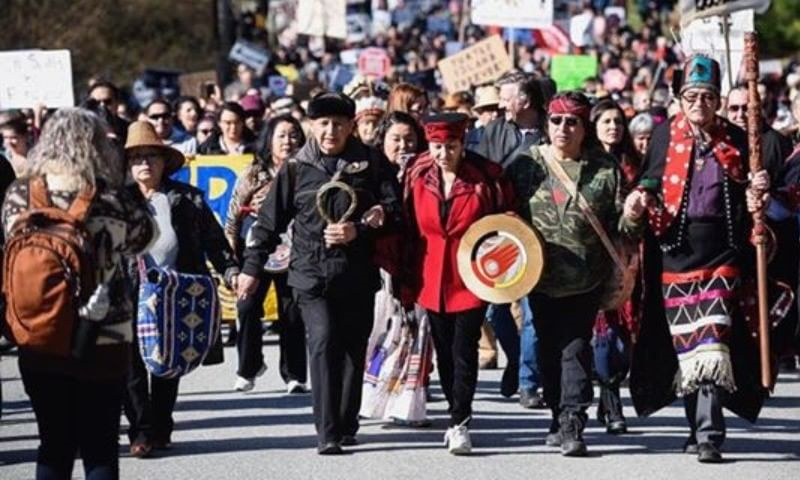
As soon as we established our Zoom connection, Joan immediately started talking about the invasion in the Ukraine and how she is supportive of the Ukrainian people who are standing up to the Russian military led by Putin. She recently attended a three-day conference with the Canadian Peace Congress and reminded me of the obligations of Canada under Prime Minister Pearson’s leadership, to maintain a peacekeeping presence in international conflicts. She also held up a beaded pin in the shape of a heart displaying the colours of the Ukrainian flag and shared her thoughts about including a white dove in her latest creation. Joan often makes active and beautiful solidarity statements through her beading and fabric arts.
When asked what she thought about how our political leaders in Canada are responding to international events, Joan responded that she is concerned about the delayed and tentative response by the Canadian government and would also like to see more strength in the opposition leaders, calling for the Russians to stand down their military and go home.
When we moved on to talk about other challenges directly affecting the residents of our COSN riding, Joan patiently explained that responses to the complex opioid crisis in BC would benefit from being more holistic. She recognized the NDP efforts to decriminalize possession as a piece in the complex reality of addiction. However she underlined that the foundational work to be done is to look at trauma. It is the root cause of why addiction exists, and there is an overwhelming necessity to support individuals, families and communities in healing and recovery.
The conversation circled back to how Covid has affected many people in Joan’s community and how interconnected the challenges are for people. There has been a lot of suffering, people have ongoing symptoms, and unvaccinated people have died. Joan mentioned that she was glad that she and Grand Chief Stewart Phillip are both working because the prices of everything over the past two years have gone up drastically and they would not be able to help support their kids and grandkids if they were living on a fixed income. Joan is very concerned about how the elderly in particular are going to be able to make ends meet. She is aware that the international instability in the Ukraine is going to further affect how much things cost. At the same time, she and Grand Chief Stewart Phillip both affirmed that it is imperative that our world leaders show the moral courage to stand up to Putin and not be indecisive.
The conversation was intense and clearly focused. Joan is a politician who is willing to take a stand, voice her belief in defending human rights, advocate for peace, and actively participate in showing solidarity.
Reporting in the Riding
Rising Above the Floods in Penticton
The devastating floods that hit the province last November affected communities all across the riding. Impacts to the people of Princeton & Merritt were great, and while the reality and extent of the flood damage has been temporarily concealed by the winter snow, the beginnings of the spring thaw are revealing once again the full extent of the mess.
Three months later, what does recovery look like?
In Princeton, locals have started to restore their houses, clean up the piles of flood debris, and pressure the various levels of government to provide more permanent housing solutions for the displaced residents who cannot return to their homes. At the same time that people are emotionally recovering from last fall’s disaster, they are now concerned about the upcoming spring melt. The town is looking to adequately prepare for future events, as the environmental conditions could easily amount to more flooding. Stella Holliday, secretary for the COSN executive, in conversation with Jeannette, shared her thoughts and feelings about floods in the Town of Princeton.
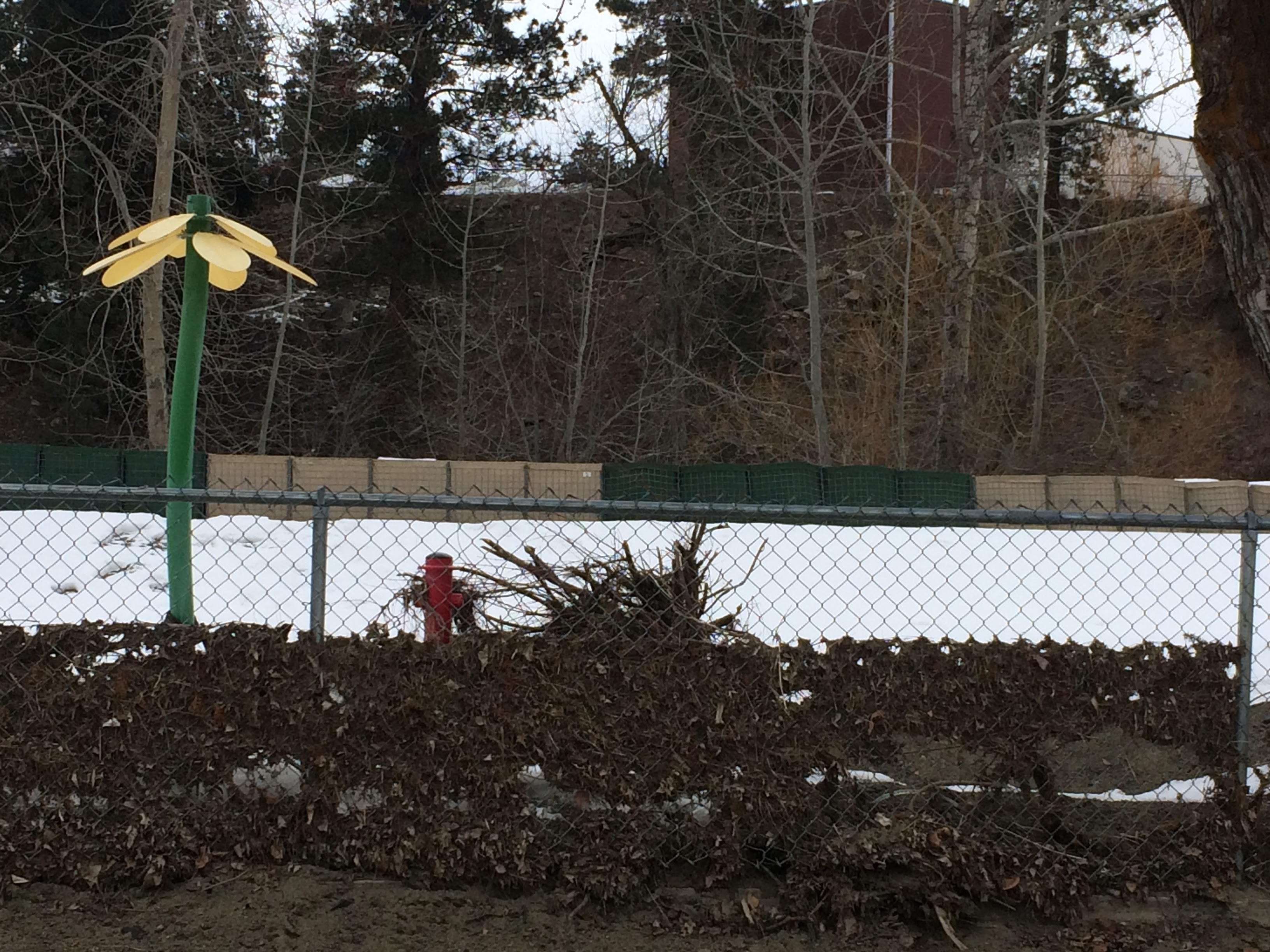 Photo taken from Lime St. looking through the fence which worked as a sieve to collect mud, leaves etc. The other side of the fence is a kids' water park with large sand bags lining the dike of the Tulameen River. These were filled by the military after the flood. (Stella Holliday, Feb. 2022)
“For a while all you saw in town was trucks, the big pumper, sucker trucks…. that phase is over now that the water mains and gas lines have been stabilized,” Stella noted. The debris in the residential streets has been hauled away to the landfill by the town staff, but in front of the many uninhabitable houses, the large dumpsters remain. What’s left is the slower, and quieter work of recovery, deciding what to keep, what to let go of, and how to do flood prevention differently.
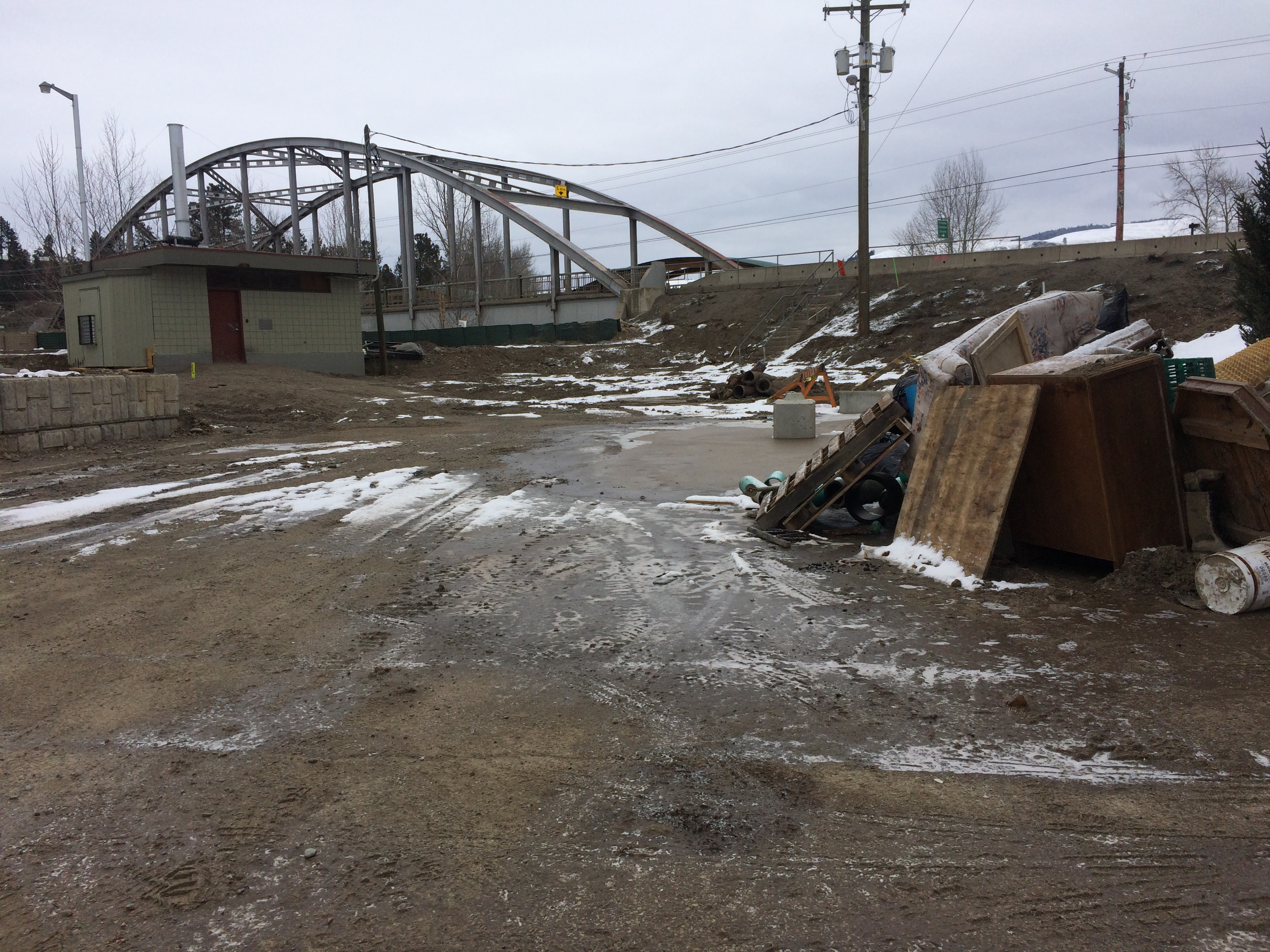 View from the bottom of Fenchurch St with the sewage lift pump in the building on the left. It survived luckily. The bridge was, for some time, the only highway route from Vancouver to the Interior of BC. (Stella Holliday, Feb 2022)
Stella, who works part-time at the Princeton District Museum & Archives, has seen the visual evidence that flooding is not new to the town, even though until last November, the current dike had been sufficient to hold the water back. She also knows that the stress of peoples’ most recent experiences will stay with them for a long time to come, “mental health issues in this are going to be big…how can you go back to living somewhere when basically, that’s [the possibility of extreme flooding] hanging over your head?”
Pushing Against the Current in Merritt
In Merritt, there is also a slow recovery and little evidence of federal support for the local residents. As with Princeton, we’re fortunate to have an executive board member, Denise Williams, to comment on the state of affairs and the challenges locals are facing in their community.
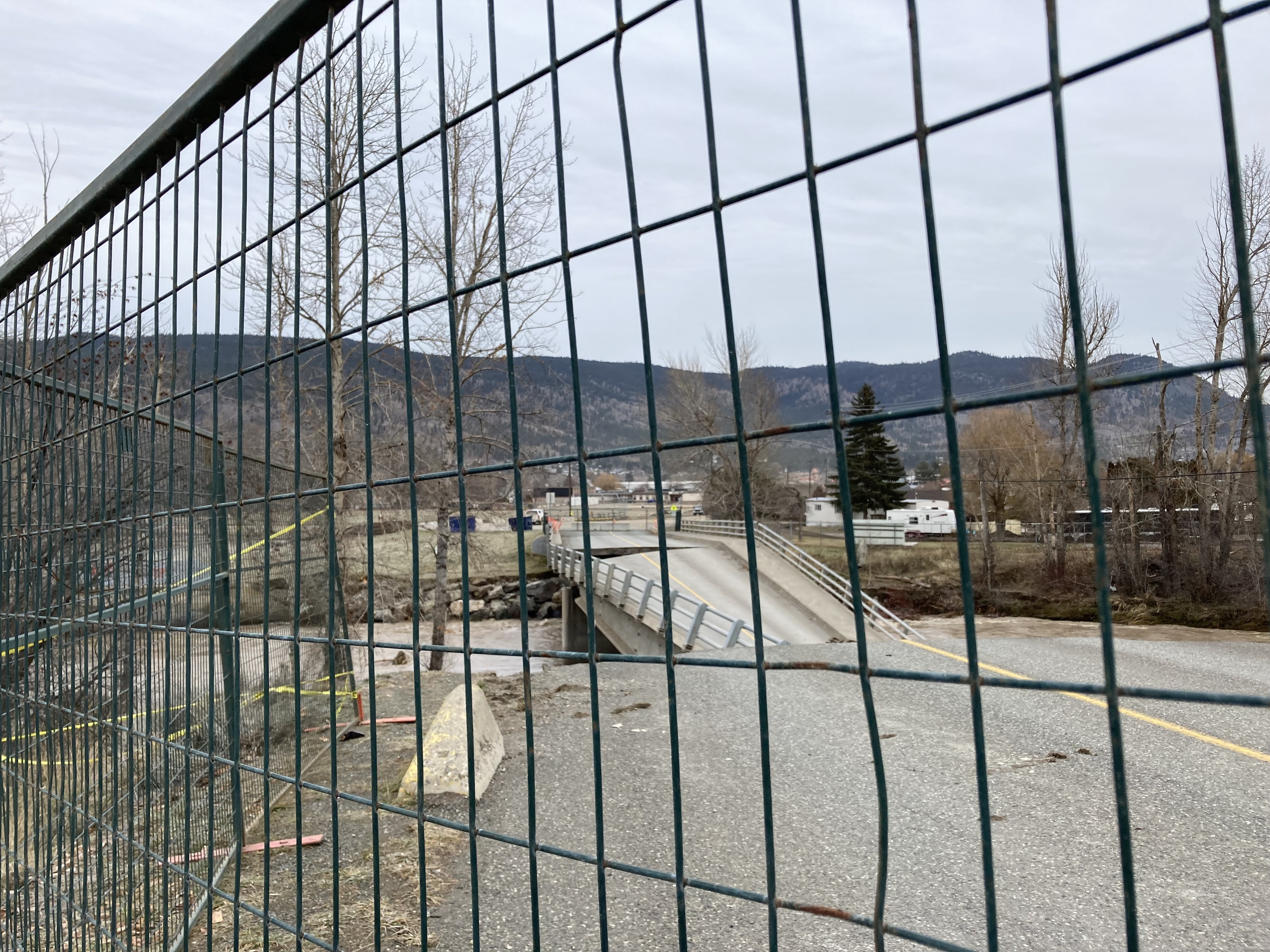 The wrecked bridge over the Coldwater River, in the background is Merritt Central Elementary School, decimated by the flood. (Denise WIlliams, Jan. 2022)
Denise, a retired teacher in Merritt, noted that students from the destroyed elementary school have been spread around to other schools and the rebuild of the new school will be elsewhere, away from the banks of the Coldwater River. Diamond Elementary and Merritt Secondary School were also damaged, but will be repaired in place. The local school board is working with the Aboriginal Advisory Council and the individual First Nations communities to support learners and families, for instance the Upper Nicola is providing classroom space for Central and Merritt Secondary.
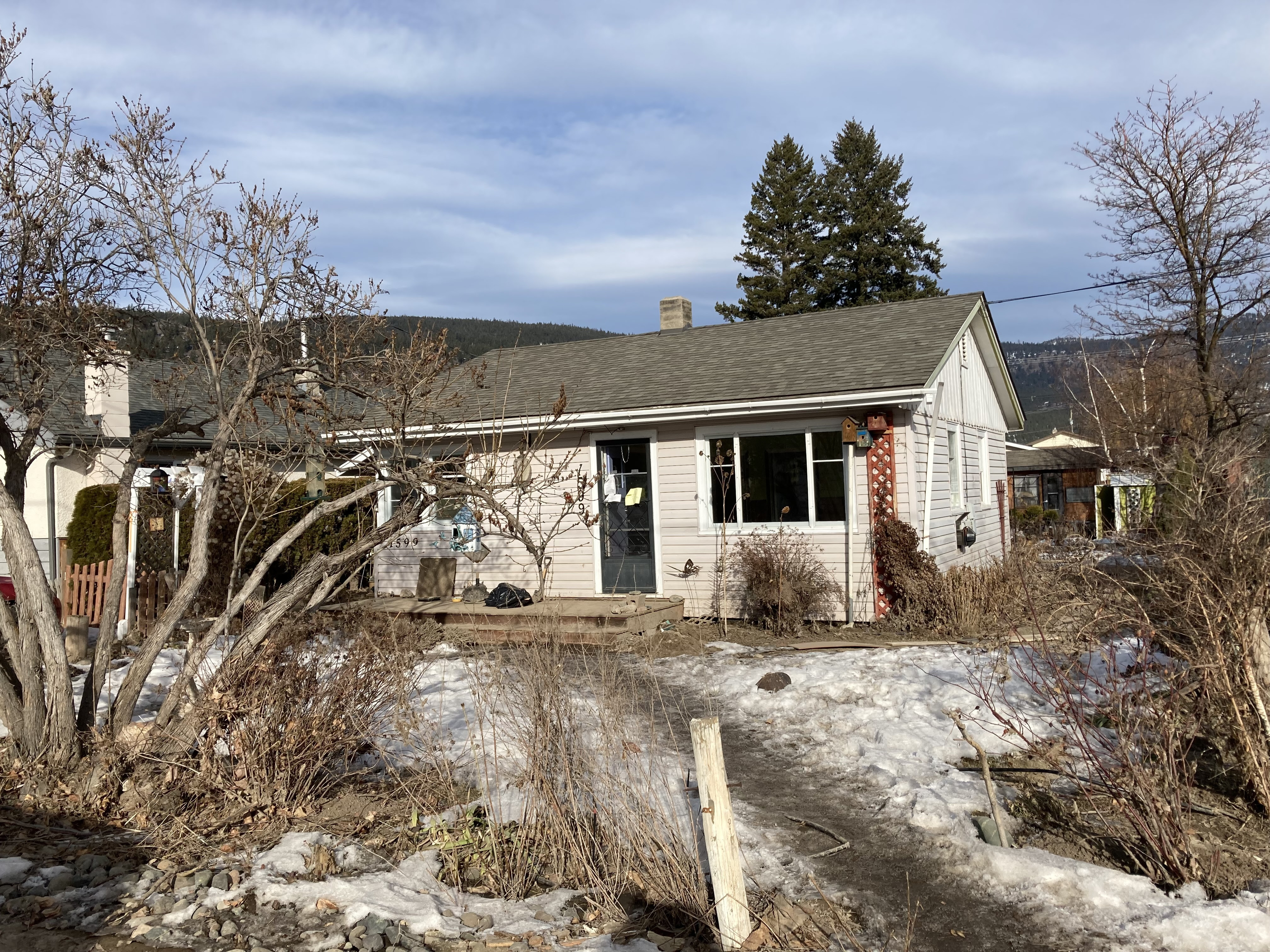 Another example of the damage and recovery can be seen in this 2-bedroom house on Canford St which is now being redone. The owner’s garden was on the Merritt Garden Tour a few years ago, so you can imagine how she feels now that her pond and fish are gone, and her yard looks like that. (Denise Williams, Jan. 2022)
Denise says there is a significant discrepancy between peoples’ perception of how the flood has been managed by the City of Merritt. Some people have found they have had excellent response and cooperation, whereas others feel they are in limbo. For all, the paperwork involved seems endless. The roads in front of some of the affected houses have been repaired and can be driven on again. The belongings destroyed by the flood waters were too much for the landfill to accept, so a huge hole has been dug close to the airport and trucks have been collecting the debris left on the sides of the roads in flooded areas and bringing it to the newly dug pit.
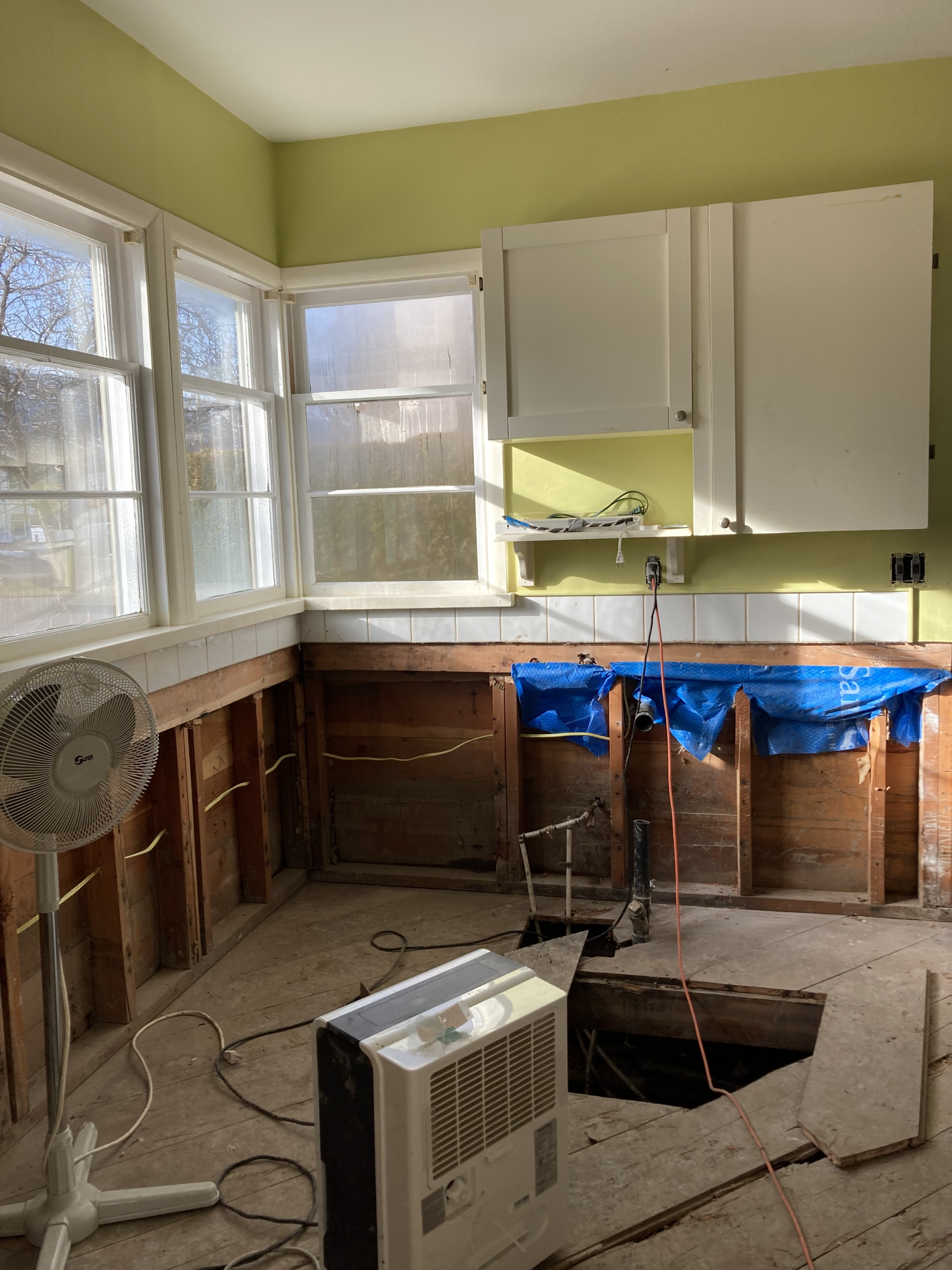 Gutted interior of the same house, with the kitchen lower cabinets, drywall and insulation removed and all appliances damaged by floodwaters and mud. (Denise Williams, Jan. 2022)
In all, more than 300 homes in Merritt were declared uninhabitable, and many other homes had restrictions on residents returning to them for the first month or more. Many people are still in Kamloops or Kelowna where they were sent when the floods occurred. More still are with families and friends where they will remain until their houses are once again habitable. Most have lost all their furniture and belongings, their houses have dryers and heaters running constantly, and the lower parts of their walls removed to get rid of any mold. People are also waiting on electricians and plumbers to get infrastructure reconnected. The residents living in the Spring St. Trailer Court lost everything. Their mobile homes were all declared uninhabitable and their temporary housing situation is precarious.
These recent experiences are a reminder of the ongoing and increasing pattern of flooding in these areas. It is imperative that local communities receive federal government support so that they can rise above the current situation and stop having to push against the current. COSN NDP members are encouraged to write letters to sitting MP Dan Albas (Dan.Albas@parl.gc.ca) reminding him of his responsibility to advocate for federal money to provide immediate and long-term solutions for the residents of Princeton and Merritt.
Grand Chief Stewart Phillip Condemns Putin
On Sunday February 27th, 2022, Grand Chief Stewart Phillip shared his thoughts with Jeannette Angel while in conversation with Joan Phillip about the need for clear leadership for people facing challenges far and near.
When Grand Chief Stewart Phillip joined the call, he spoke very clearly about his disappointment in the lack of leadership shown by the Prime Minister, and the slow response by the opposition leaders. Grand Chief Stewart Phillip expressed the need to be very firm about Putin’s aggressive behaviour which he believes mirrors the build-up of World War II. He explained that in contrast, the Union of BC Indian Chiefs (UBCIC) is committed to acting decisively and responding to current events in a timely manner. UBCIC issued a condemnation of the invasion of Ukraine on March 1st, 2022. In the media release, Grand Chief Stewart Phillip, UBCIC President, stated that “as Indigenous peoples, we fully understand what it is like to have our peoples attacked and our lands and resources stolen at gunpoint.” UBCIC therefore “calls on President Vladimir Putin to immediately withdraw all Russian military forces from Ukrainian soil and go back to Moscow to face full punishment for their brutal war crimes and political accountability to the outraged Russian citizenry.”
The full statement can be found here: https://www.ubcic.bc.ca/ubcic_stands...e
Later in the Zoom conversation Joan explained the structure of decision-making and action at UBCIC, where a team prepares research binders for the chiefs to consult as part of their coming to decisions and issuing public position statements. UBCIC is mandated to respond to the issues and events that fall within their areas of responsibilities, “to act as an advocacy body to provide a cohesive voice (regionally, nationally and internationally) in support of Indigenous Nations and communities, and to promote and protect each Nation’s exercise of Sovereignty within their traditional territories.” https://www.ubcic.bc.ca/mandate
Grand Chief Stewart Phillip is an influencer in the best possible sense of the word. He is a leader, the President of the Union of BC Indian chiefs, and leads a team that is very effective in communicating the UBCIC position on every single important issue that arises. This is inspiring and serves as an example of true democratic process.
Standing on the Soapbox
We are committed to providing a space for people to voice issues personal to, and affecting the people of, this beautiful and diverse riding. For that reason, we’re dedicating an ongoing section of Updates to publishing original articles submitted to us by Updates subscribers. To kick things off, we have a piece written by a member of the COSN NDP Riding Association Executive on matters close to her heart.
From Donna Suzanne Stocker comes a pair of articles. First is an analysis of Canada’s first past the post voting system (a future edition of COSN Updates will feature her argument in favour of proportional representation). Her second article takes us back to 2013 and the redrawing of our electoral district, and the problem with fixing boundaries.
Winner Take All - Why Our Voting System Does Not Work
by Donna Stocker
The voting system we use now in Canada is called Single Member Plurality (SMP), or First Past the Post, (FPTP). It’s a winner take all system. Under this system, the party that gets just one more seat in parliament than their closest opponent, wins 100% of the power. The most high-profile countries in the world that still use this antiquated voting system are Canada, the US and UK.
This system was not designed for a multi-party situation and frequently hands a voting majority to a government that lacks popular support. After an election, FPTP leaves as much as 60% of the people feeling unrepresented and the newly elected government able to impose their policies on everyone in the country. And no one seems to have the power to stop them. When a party has a majority, they are given free rein to impose their policies on everyone in the country, and break their campaign promises, with no opposition strong enough to stop them, even if the parties in opposition gang up together.
During elections, parties will focus on ridings that they know can win. There is no point on focusing on a riding that is a shoo-in, or a riding that has no chance of winning. Winning a riding by a few votes is more satisfying than winning a riding by a huge margin. Losing by a few votes stings. Losing by a large margin is a shrug because they didn’t expect to win and didn’t expend much energy into that riding. It stands to reason that the no chance riding will not be represented as well as some others.
Large parties will target smaller parties and take over some of their popular policies, muddying the waters and killing the diversity of parties to choose from. This co-opting of policies, in time, leads to the cementing of a two-party system as less established parties become fringe parties or places to put your protest vote. The lurching between two main parties, each one undoing what the other party did when they were in power before implementing their own policies, is non-productive to say the least.
Soon voting becomes a problem because of the lack of options, so people think why bother? They say: “The candidate I like has no chance of winning…” “The front-runner is a guy I can’t stand.” Or, “the front-runner is a really good guy but he belongs to the wrong party...” Then what?
People turn to strategic voting, spoiling their vote, or just not bothering to vote at all.
There are, thankfully, other systems, and I’d like to discuss more of them in future issues.
Fixing the Riding Boundaries - What Happened?
by Donna Stocker
In Canada our electoral boundaries change every ten years. This is to adjust for population changes using the last census taken. Although this process is supposed to be implemented at arm’s length from the government, it does not appear to unfold that way. The new boundaries often favour the government in power. That’s called gerrymandering and it suggests government interference and is hardly at arm’s length.
At the provincial level we saw a case of gerrymandering in Vancouver in 1982 that caused a huge stink all across BC. It was called “Gracie’s finger.” Grace McCarthy was a pretty important figure in the ruling Social Credit party. Her riding was in Little Mountain in Vancouver. Some of the demographics were changing a little bit and jeapordising an easy victory in her riding. When the new boundaries were drawn up before the election, lo and behold! the new boundary included an area from 16th to 33rd along the Arbutus Street corridor, a very wealthy area, that ensured her a win.
When the boundaries of my federal riding, what was then the South Okanagan –West Kootenay, were being remapped in 2012, I attended a meeting with Alex Atamanenko, our NDP MP. Two judges and their secretary were there to listen to suggestions. Representatives from every area of our riding were there as well with ideas and suggestions. (The following map shows my previous riding shaded in pink.)
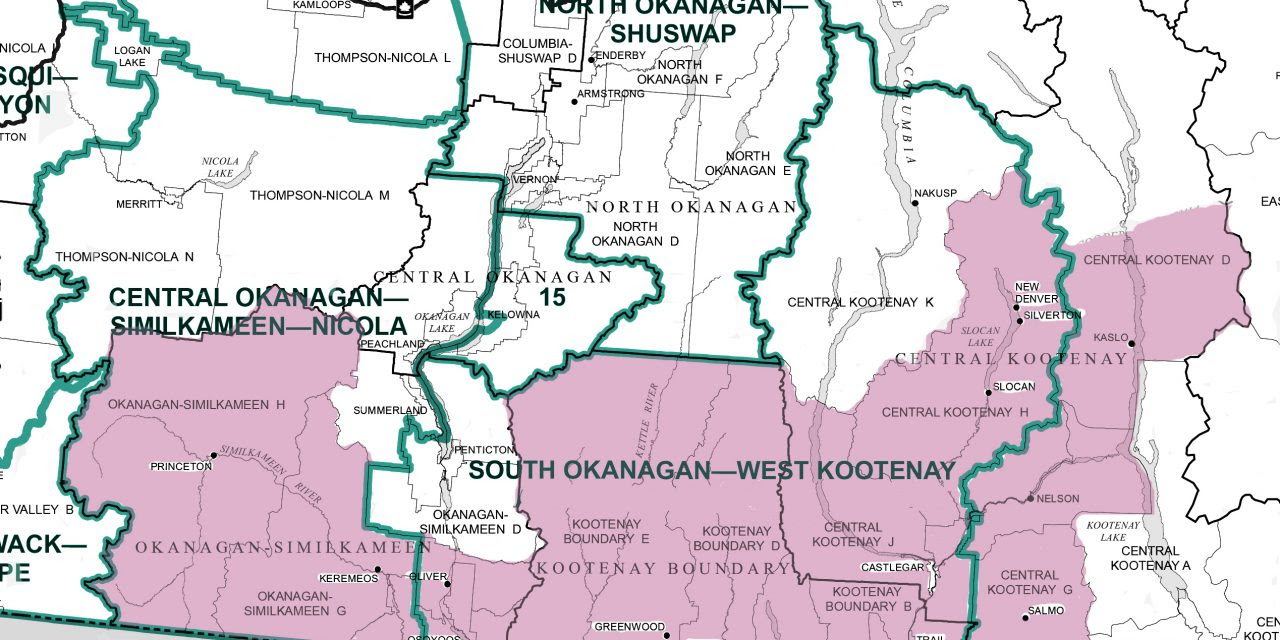 The boundaries for the new federal electoral districts in the B.C. Southern Interior were created in 2013, and they are indicated on the map by the dark blue lines. The pink shading shows the former riding boundaries, which were help by NDP MP Alex Atamanenko from 2006-2015. (Times Chronicle)
The judges were asked to take into account that our riding covered at least two mountain passes that were very dangerous in winter, and it would be beneficial to try to make the boundaries along rivers or mountain ranges. There were heartfelt pleas from the representatives of the municipalities of Penticton and Summerland that they not be divided federally, as they and their MP were all working together well.
In the Keremeos/Cawston area, our case was pled to leave us with the rest of the farming area running west-east along Highway 3, and not include us with Kelowna, to the north, as was planned. It so happens that Highway 3 east of us is also a farming area and they also predominantly vote NDP. The area around Kelowna historically voted differently.
For a little context let me explain that Jack Whittaker was our NDP MP when I first moved to Cawston in 1987. He held that position until 1993 when the riding boundaries changed. Jim Gouk ran for the Reform Party and won in 1993, again in 2003 for the Alliance Party, and finally for the Conservative Party in 2004. Alex Atamanenko, our NDP candidate ran against him that year. Alex won the seat in 2006 and held it until 2011. Our riding boundaries were changed again in 2012 and we’ve had a Conservative MP ever since then.
During the meeting the judges smiled, nodded and took notes. I went away feeling pretty good that they had listened to us. But when the new boundaries were published, the proposed changes were almost exactly the same as they were before the meeting. Penticton and Summerland were split up in a most unusual way.
My federal riding boundaries since 2013 are from above Logan Lake, down to the border, east to Chopaka, then north, passing around Penticton, and resuming again in Summerland to Kelowna, then west back to Logan Lake.
From my perspective, our riding is mainly rural, and includes ranching, sawmills, small farms and orcharding. To have part of Kelowna in the mix feels like a monkey wrench got thrown in. Rural and Urban issues can be quite different. There must be more accommodating ways to map out boundaries.
Taking Action
We have no shortage of causes worthy of attention across the riding, the province of BC, and the country as a whole. A list of active petitions put forward by the Federal NDP can be found at https://www.ndp.ca/action-centre, and for the month of March we would like to highlight one specific fundraising event near to us.
Hell or High Water Disaster Relief Concert & Telethon
For those interested in making a more direct contribution to provide relief for the communities impacted by 2021’s devastating fires & floods, we would like to draw your attention to the Hell or High Water Disaster Relief Concert & Telethon fundraising event.

"The 'Brothers of Tourism' at EH Canada Travel, Kenny Hess (Founder of Rockin’ River Music Festival), the Citxw Nlaka’pamux Assembly representing the Nooaitch, Coldwater, Shackan, and Cook’s Ferry Indian Bands, Tourism Nicola Valley, Experience Nicola Valley and the Rotary Club of Merritt are all proud to step up and present the 'Hell or High Water Fundraiser'.
Hell or High Water is an all out two-for-one 12 hour online fundraiser consisting of a live streaming telethon with musical performances, messages, vignettes, videos from dignitaries, locals and musicians, as well as, a live concert from the Clarke Foundation Theatre in Mission, BC, Canada. All in an effort to raise money for the people of the fire and flood ravaged communities of Merritt, Lytton, Princeton and Abbotsford, British Columbia, Canada, as well as, the surrounding First Nation communities.
Musicians, celebrities, dignitaries, media, corporations, companies, and people just like you and us are all coming together to raise money for our friends in trouble in British Columbia, Canada. We are accepting donations now, prior to our fundraiser. Donate today, so you can enjoy the show. It promises to be an event filled with music, special guests, entertainment, shout outs, personal messages, videos, live streaming, and, we hope, some much needed bloopers bringing smiles to our faces when we could really use some."
Mark your calendars for Sunday March 13th, 2022. Tune in and donate, if you can, at https://hellorhighwater.ca/.
What's Next?
Through future editions of the COSN Updates, we look forward to shining a light on matters most pertinent to the people of our beautiful riding. Later in March, we plan on going live with a website to operate as a hub providing a permanent home for editions of COSN Updates, contact information for regional supports & services, and ways to get involved in the riding and beyond.
Thank you for staying updated! We look forward to sharing more with you as it happens.
